The Power of Poetry, Community, and Ambition: A Conversation With Alice Faye Duncan
Reading Is Fundamental (RIF) is dedicated to inspiring the joy of reading by connecting children with books that ignite their curiosity and imagination. RIF believes that by cultivating a passion for reading, children can build the foundations essential for a prosperous future through the countless opportunities reading can provide, something we believe every child deserves.
Few embody devotion to this mission more than Alice Faye Duncan, award-winning author, National Board Library Media Specialist, and proud Memphis native. With a writing career spanning decades and over 15 titles published, her dedication to children’s literacy is undeniable, with her recent participation as a guest author at Bookstock (one of several Books Across the Country events celebrating RIF’s 60th anniversary) bringing her directly to young readers through read-alouds, conversation, and book signings. Read on to learn more about her work, impact, and the enduring power of storytelling.

Hi Alice Faye, thanks for your time. What is your earliest memory of reading?
I remember it very, very well! I was an only child, and at the end of each day right before bed my mother and I would have story time. It was my favorite part of the day! My mother was a schoolteacher, and although I didn’t know it at the time, she had an illness that drained her energy. So, she would read me different fairytales or nursery rhymes, but there would always be a certain time during the evening when my mother would fall asleep while she was reading to me. My refrain at that time became “I can’t wait until I can read for myself!” because I became so weary of my mother falling asleep. In first grade, I remember the first week of school we started learning how to read. It was the most liberating feeling I had ever had. It was great.
And what about writing? We’re curious about what sparked that interest for you.
Both my mother and my father taught school, so every room in our house had a bookshelf – I’ve been surrounded by books all of my life. When I was a child just learning how to read, the books on those shelves that were the easiest for me were poetry books. I could read books by Langston Hughes, Maya Angelou, and Gwendolyn Brooks. Poetry books were very accessible to me. There’s all that white space and the words were easy to understand, for the most part. I’d been reading poetry since I learned how to read, and what happened was that I began trying to write my own poetry. When I learned how to read, that was also when I began my attempts at writing.
Here’s something else that is very important about my writing from when I was young – my mother did not read, per se, Paul Laurence Dunbar, but she’d recite his poems to me. Of course he writes in an African American vernacular, a very Southern vernacular, so my early poems were in that spirit, much to my mother’s chagrin. She would say, “Oh, Alice, this is not correct English!” I’d respond with, “But, Paul Laurance Dunbar was writing poetry like that. Langston Hughes was writing poetry like that.” And that became my response when I reached fifth grade and had a great facility around language and how to read and interpret it. I’ve been writing in African American vernacular (AAVE) since I first started writing. My very first book was written in AAVE. I don’t do it so much now because I have other things to write about, but I think it says something about the literature that influenced me.
You come from Memphis, a city with rich cultural influence. Tell me about the community you come from and how the city has inspired your work.
Memphis has inspired my work in a mighty way. I was born in South Memphis, and on my street my next door neighbor was J.O. Patterson Jr., one of the first Black city councilmen in Memphis. He was also one of the councilmen who helped put an end to the 1968 Sanitation Strike. Across the street lived Officer Ed Redditt, one of the first Black detectives in my city. It was often his responsibility to follow Dr. Martin Luther King Jr. when he was in Memphis. I grew up in the African Methodist Episcopal Church, and my pastor, Reverend Dr. Henry Logan Starks, was a strike strategist for the 1968 Sanitation Strike. The church photographer was Earnest Withers, who is credited with taking many of the early photos of Dr. King and other Civil Rights activists in Montgomery and Memphis. These are just some of the people from my community.
And being born in 1967, I grew up in a time where my community was talking about Dr. King, and telling me that it was my responsibility as a Black child to go to school, it was my responsibility someday to vote. When I became a teacher in the early ‘90s and I’d bring up the topic of Dr. King, I realized very early on that children here in Memphis, a city that is oftentimes considered the epicenter of the Civil Rights Movement, could not tell me things that were important. For instance, if I asked them to hypothesize why Dr. King was killed, they could tell me that it happened at the Lorraine Motel but couldn’t tell me that is was because of his views on economic equality or justice. I began to seriously consider, “what do I need to write about? Where are my words needed?” So, I wrote Memphis, Martin, and the Mountaintop, one of the first picture books to speak on the assassination of Dr. King for young learners. I’ve now been writing about Dr. King for over 30 years, and I’m always searching for something new about his life that young readers should know.
You mentioned Memphis and culture – Memphis is considered the home of the Blues and the front door of the Mississippi Delta. Blues music is American music. As a teacher I realized that if Blues music is to live, to survive as American music, then children need to know it! They need to know the music and be familiar with Blues musicians. Because I’m from here, I’m extra interested in the musicians that come from the Memphis and Mississippi Delta area.
So, I’ve taken it upon myself to write about the Blues in books like Yellow Dog Blues. I wrote about B.B. King who is considered the king of the Blues. I have an upcoming book about Delta Blues musician Robert Johnson, who is considered the father of Rock 'n' Roll. It will look at Robert Johnson through the lens of Juneteenth – what people don’t know, and this even includes some Blues aficionados, is that Robert Johnson was in Dallas on Juneteenth, when he recorded his last music! I want to write about American history, and I want to write about Black history. So, I’m trying to capture those elements that aren’t always popular but are vital and important for not only children, but all of us to know.
When you were an educator what age groups were you working with?
I was a school librarian for 30 years. I started off in elementary school, but my last 22 years were spent teaching high school students.
I bet you learned a lot from those students. Does anything in particular stick out?
So, here’s the thing – what I realized being in that school environment was where the gaps in the curriculum were. I knew then what was really urgent for me to write about.
Here at RIF we really believe in the connection between inspiring reading joy and the lifelong benefits that can come from being a proficient, passionate reader. I’m curious, what are some ways you think reading can be inspired and not forced upon students?
I think one of the things that can help children have a great appreciation for reading without it being drudgery is if we introduce poetry to them at an early age. Introducing poetry early and frequently can work in the same way as a sacred text. Many of us, no matter what religion, have a sacred text, and it is dear to us because there is something inside that sacred text that brings us comfort or offers us encouragement. I believe that poetry can do the same thing for young children. But oftentimes in school, the teacher is forced to be very focused on the curriculum and test results, so there’s not a lot of room for the teacher to have time to focus on poetry, to focus on creative writing, to focus on letting children explore what they want to explore.
Another way is to let children read what they want to read. We don’t need to put a prescription on it! By allowing children to focus on what they are interested in, we can avoid the grotesque refrain that I hate to hear – “I don’t like reading!” It’s not that they don’t like reading, they just have not yet discovered the book that they enjoy.
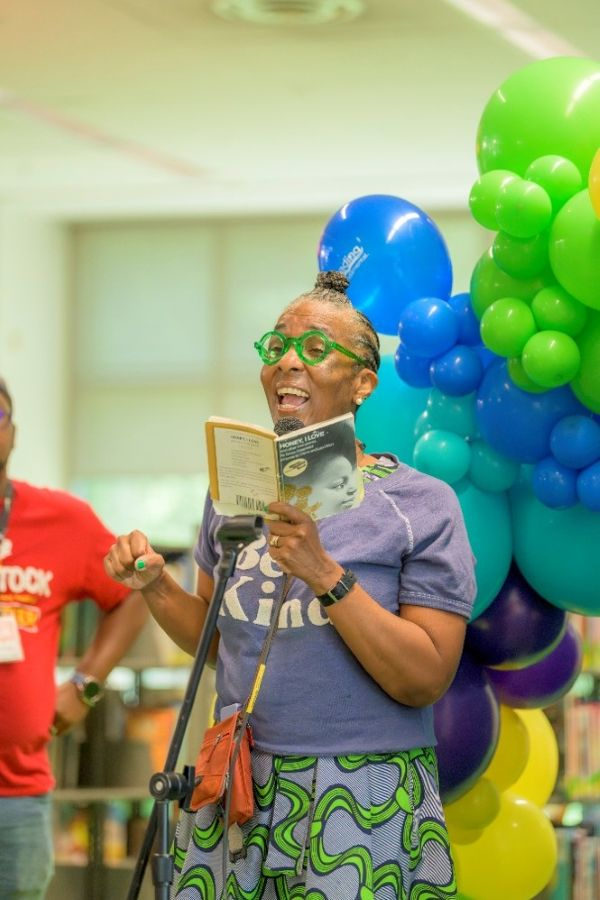
You recently joined RIF as a guest author at Bookstock for one of our 60th Anniversary celebration events. We had a lot of fun! What did you think of the event, and why do you think events like these are so important for the community?
There is a high poverty rate in Memphis and oftentimes, parents are not pre-occupied with purchasing books for home libraries. So, for RIF to provide books and allow parents and children to pick books and take them home to keep, that is very powerful. Then they have a book that they love and cherish. It is theirs! It doesn’t have to be returned, and it can become as dog-eared and loved as they want it to be because of that.
To have me there, and other authors there, who can autograph those books, means that not only are students receiving books they did not have to purchase, but they are receiving, at least for many, their first autographed book. I think it’s very powerful and encouraging for the child. Bookstock also happened to take place in the public library. Hopefully many of the parents and children who attended that aren’t frequent visitors become public library patrons!
Have you’ve been reading anything good lately?
The last good book for adults was Kin by Tayari Jones, but my favorite children’s book that I read often is Honey, I Love by Eloise Greenfield.
Out of all of the books that you have written, is there one that feels most precious to you? I know that can be a difficult question to answer!
It’s like a mother with her kids – how do you answer which is your favorite? I love all of them! But I have two answers for that. There is my book called A Song for Gwendolyn Brooks. It is the biography of Gwendolyn Brooks that I wrote in nine verses. It focuses on her, her family, and how at a young age they identified that she’d become a poet. It’s one of my favorites because before my mother passed away it was her favorite. I think my mother saw herself and saw me in that story.
The second is a book that I have called This Train is Bound for Glory, which is an American Gospel song that I put into book form. It’s about all these people who are on their way to Heaven. Now that both of my parents have passed away, each time I read that story I always imagine that my mom and my dad are a part of that motley crew that are aboard that glory train. So it’s always fun to read that one to children because I can share with them the joy of what I think Heaven is, and I get to tell them about my mom and my dad who both did such a wonderful job.
Is there any advice you wish you could give 9-year-old Alice Faye?
Yes. I would tell 9-year-old me that you have to write, write, and write again. The first draft is not your best writing. The second draft is not your best writing, and it may not even be the third draft that is your best writing. It is revision that makes poetry sing. I’d tell my young self that because little me would be satisfied with that first draft. But now after all these decades I know that the first draft is never the best. Things can always be said better. So, to 9-year-old me, do not despise the editing process! Also, read more poetry. Read more novels, yes, but read more poetry so you can capture the power of metaphors. A lot of great writing stems from the ability to say something that has not been said before. Poetry really masters metaphor and inspires you to come up with your own.
What is your favorite poem or book from when you were a child?
When I was younger, my favorite poem was the one my mother would sing each day to wake me up, Paul Laurence-Dunbar’s In The Morning. It goes:
“’Lias! 'Lias! Bless de Lawd! Don' you know de day's erbroad? Ef you don' git up, you scamp, Dey 'll be trouble in dis camp!”
To wrap this up, do you have any parting words for the audience?
I do. It’s the poem that comes from my book Memphis, Martin, and the Mountaintop. It is called Mountaintop. It goes like this:
“Dream big, walk tall. Be strong, march on. Don’t quit, never stop. Climb up the mountaintop. Climb up the mountaintop.”
Visit Alice Faye Duncan’s website to learn more about her work and commitment to children’s literacy, and discover some of her titles, along with accompanying reading resources and activities, available on Literacy Central. Learn more about RIF’s 60th Anniversary and upcoming community events here.